Facilitator: Sean Nittner
Players: Karen Twelves, Dale Horstman, Matthew Klein, Sean Nittner
System: Shock: Social Science Fiction by Joshua A.C. Newman
Shock: Social Science Fiction is Joshua A.C. Newman’s fiction game of culture and future shock. Shock pushes players to make stories that matter to you — stories about politics, philosophy, love, and death.
At the core of the world-creation system is the Grid, a method of world creation that crosses social concerns with Shocks to build a fictional world, custom-built for the type of story you want to explore.
Use your ownership to give detail and vibrancy to the world, or wait until you’re Audience to apply your editing to each scene, building continuity and adding richness through Minutiæ.
Players pursue the interests of both Protagonists and Antagonists, drawing on their principles with motivation and resources. Play highlights what you care about as a player and gives you the tools to highlight and question the things you care about.
Build your future. Burn it down.
Build a new one.
The latest game in our 00s revival project is Shock. It’s been on my bookshelf (version 1.1 and 1.2) for ages and I knew that it was about creating your own Science Fiction future where the world has changed in some fundamental way, like the existence of replicants or hive minds.
I talked to Joshua before the game and he gave me some advice, which I shared with the group, and we 100% didn’t follow. We’ll see if that is to our own peril:
Don’t let the Grid process go on more than 10-15 minutes, tops. Use the rules to make stuff happen.
We didn’t do that. Our fist session was composed creating the shock, issues, minutia, protagonists, and antagonists. We had a great time and I feel like we have a developed a future that we all had a strong understanding of. I flagged a concern that we might have built structures that were too developed and find ourselves adjusting them in play, but we’ll see how that goes.
Shock: Emotions have a Governor
Do you ever just feel overwhelmed by it all? No? Me either.
Just as your shower can’t get too hot, the people of Western Americas (formerly part of the United States) agreed that strong emotions, particular despair and anger, were the cause of societal ills. To prevent this, all cell towers emit a frequency (the “Freq”) that prevents people from experiencing strong emotions. Happiness is possible, but elation is a memory. People are sad when they lose a love one, but they do not fall in wells of despair. Getting cut off in traffic might make you angry, but not to the extent that you would start driving aggressively
Because the Freq cannot reach all locations, building basements or areas where signals can’t penetrate is strongly regulated. Similarly, anyone can leave the Western States, but they are waned that barbarism and violence awaits them. If they want to return, they must go through a period of emotional quarantine before reintegrating with society.
As a table we decided that we did not want to play in a totalitarian future where this was forced upon people. This is a more subtle form of control. People willingly consent to the suppression of emotions because they believe it is safer, or that they will have a better life, or because the were raised in the society and don’t know anything else. Even for the folks who don’t like the idea of losing their autonomy, many stay because leaving would be much harder.
Issue: Craving Emotions
There are some people that are resistant to the Freq, and the dampening of their emptions creates a yearning to feel more. Most have learned to hide these feelings and desires, but they often feel restless, like they have an urge to create something, but can’t. These people are often artists, creatives, and romantics.
Issue: Suppressing Art
For the good of society, most art that was created before the Western States was found can only be experienced in “Viewing Museum” where the Freq has been amplified and virtually no emotions can be felt.
Society values impermanence and when new are is created, the expectation is that it will be destroyed. Parroting Buddhist values, mindfulness is taught to come from having an experience but not holding onto it.
The only new art that is lasting must be approved by government officials.
Issue: Rewriting History
History has been rewritten and distorted as propaganda for the foundation Western States. Everything good and lasting and beneficial to society is framed as coming from people who are thoughtful, selfless, and not driven by their emotions.
Atrocities of the world, hunger, war, and disease, are all framed as outcomes of impulsive and emotional acts.
History is sensationalized and many people enjoy historical media as it is a sanctioned way to feel slightly heightened emotions, though the emotional reaction that history texts drive towards is complaince.
Issue: Apathy Epedemic
Just as there are some people who are resistant to the Freq, there are others that are affected by it too strongly, and cannot feel anything at all. Called Lambert’s Syndrome, after a French doctor who first diagnosed it, there is currently no understanding of what causes it.
Lambert’s Syndrome usually develops over time and people how experience it often develop skills to fake having emotions or caring about things, as they do not want to be seen as sick.
Treatment for it is done in secluded facilities where the sick can be kept away from healthy members of society. The facilities have similarities to retirement communities and psychiatric wards. Scientists are still looking for a cure, but one has not been found yet.
If untreated, Lambert’s Syndrome can lead to violence and self-harm, usually in the form of neglecting to take care of yourself.
Praxis
We decided the Scales for our Praxis would be Impulsive over Mindful, Subversive over Compliant. These reflect our interior thoughts and the way we are seen by others.
*tagonists
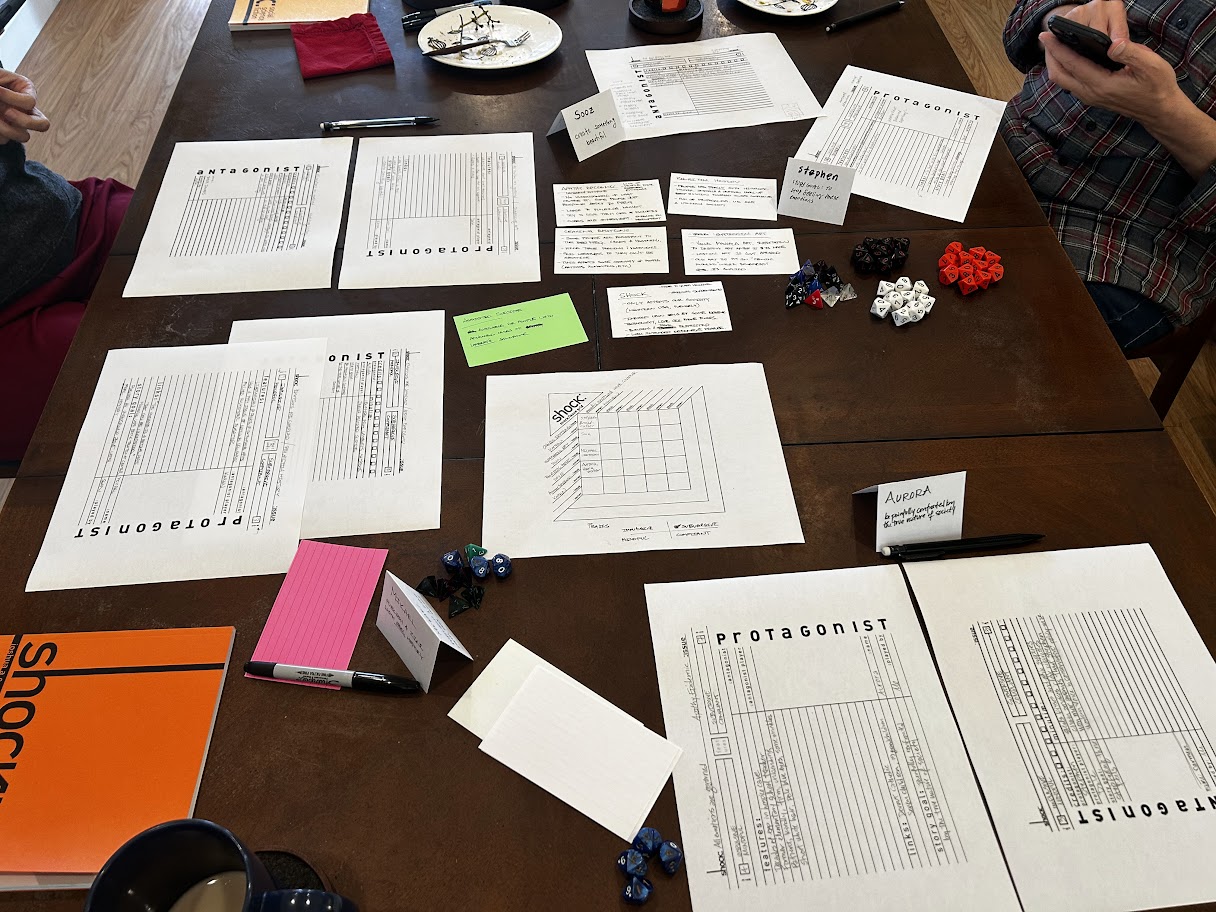
Here are the pairs of our protagonists and antagonists
Protagonist Mikael (played by Sean) is a librarian at the Palace of Contemplative Arts (where the Palace of Fine Arts used to be), a place where emotions are fully suppressed. He owns a 1994 issue of National Geographic, and wears a pilled polyester sweater. Fulcra 7,3. Links: Belief that the universe is a rational place that can be understood, and Minerva, my wife who is being treated for Lambert’s Syndrome. Story Goal: Publish an underground zine with real history.
Antagonist Breck Danvers (played by Karen) is a wealthy donor to the Palace who knows that if you have enough money, you can break the rules. Fulcra: 3,3 (All impulse and subversion all the time!)
Protagonist Sooz (played by Karen) the human in the look for art approval. She fosters kittens and is indecisive about small decisions, believing they will all have huge impacts on her future. Fulcra 7,7. Links: The butterfly effect is real. Walking club b-ddy, Annie. Story Goal: create something beautiful
Antagonist Majenta (played by Dale), Sooz’s sister who is a very successful artist that has had many of her works approved by governing bodies. Her work is universally shit. Fulcra: 3,3
Protagonist Stephen (played by Dale) is an award-winning news broadcaster that presents disaster stories in palatable formats. He does risky and self-sabotaging things just to feel something. Fulcra: 4,7. Links: In love with his camera person Carmen. Really believes in the truth of this place. Story Goal: Stop having emotional cravings.
Antagonist Carmen (played by Matthew) works with Stephen, has one more awards than him, and gets a thrill out of defying the company rules preventing inter-office relationships. She steals kisses and office supplies, and chain smokes clove cigarettes. Fulcra: 3,3.
Protagonist Aurora (played by Matthew) has decades of experience in hospice care and was formerly an elementary school teacher. She is patient, kind, firm, and unbending with short white hair, pale blue eyes, and some wrinkles. Fulcra: 4,7. Links: Devout Catholic. Seven children (including Mikael), 19 grandchildren. Story Goal: Painfully confronted by the true nature of society.
Antagonist Aspen (played by Sean) suffers from Lambert’s Syndrome. She is Mikael’s wife, and Aurora’s step-daughter. She is seeking assisted suicide because none of the treatments have worked for her. Fulcra: 8,8.
Thoughts on the Game
We had lots of questions about how to create an antagonist. Do they seek to prevent you from reaching your goal, or just make it a difficult decision? How do we make one that can be omnipresent so it makes sense for them to be in any scene? As the antagonist, do we have GM like authority in a scene? We assumed yes, but if we want to use an issue or shock owned by another player, they have authority over it.
The key for me was having connections that were personal and intimate. Someone directly involved with the lives of the Protagonsits.
We definitely took longer than 10-15 minutes on our grid, and that might lead to feeling like we’ve already played the game before we played it, but I’m excited to see how it turns out.
I’m glad that we pulled back from the idea of an overtly oppressive regime. We’re all being controlled, but there is a veil of self-help jargon that makes it all feel voluntary. More Stepford Wives than Equilibrium.
Excited to play and create more minutia and see how our protagonists change.
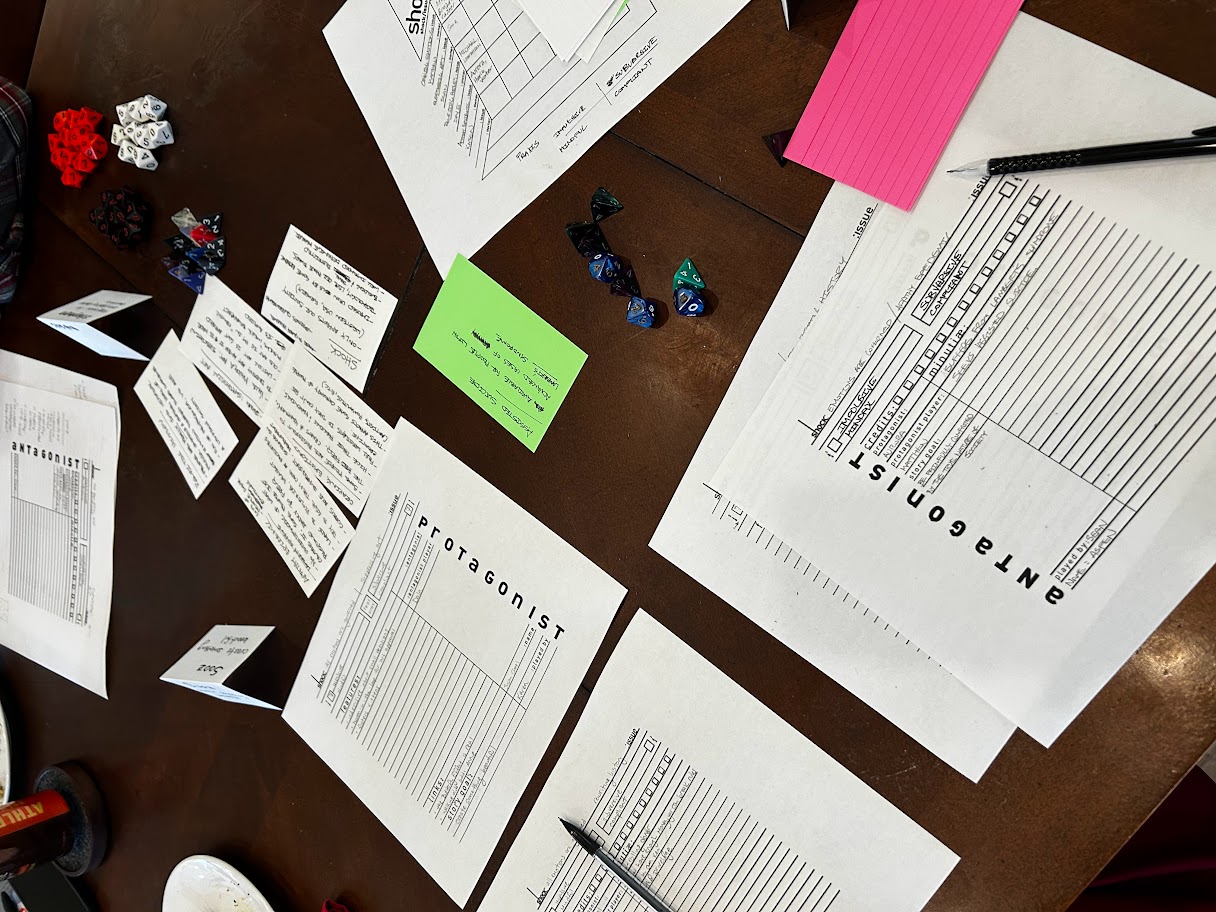
Our table and our spread (created by Karen)

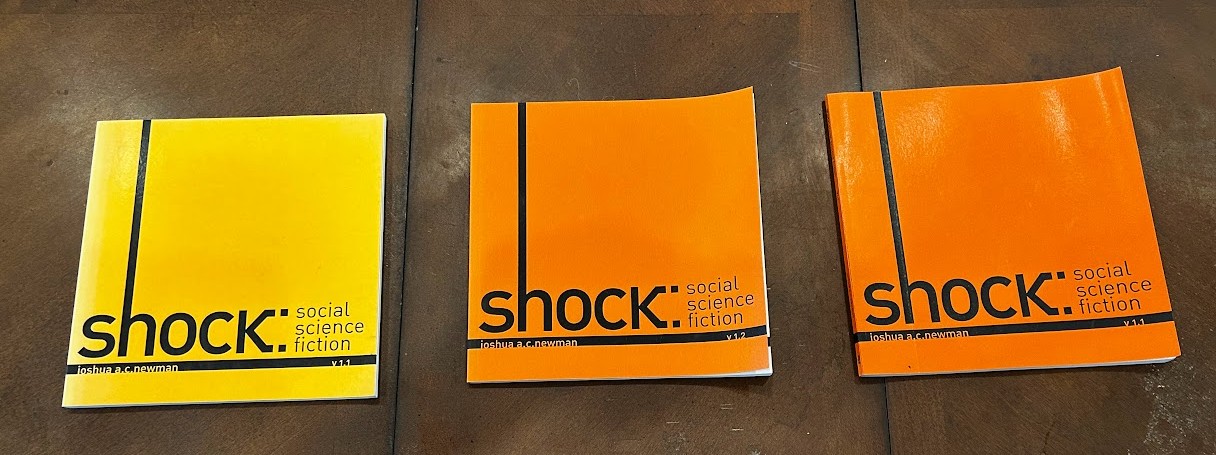
Three copies, two versions, all different colors 🙂



Pingback: *tagonists (10/11/2026) – Sean Nittner