GM: Sean Nittner
Players: Karen Twelves, Dale Horstman, Matthew Klein
System: In A Wicked Age
I don’t think In A Wicked Age was a good fit for my group, both for procedural reasons that could be improved with greater familiarly with the game, and because the play style required clashed with our preferences.
Process challenges
I was learning the game as I was teaching it. I’d read the book a few times but because the instructions are given by example, I was constantly decoding the examples given that reference the characters “Amek” and “Mekha” as well as the players “I” and “you” into general rulings like “everyone picks two traits that how and why they are acting” and then re-encoding to address the specific situation at our table.
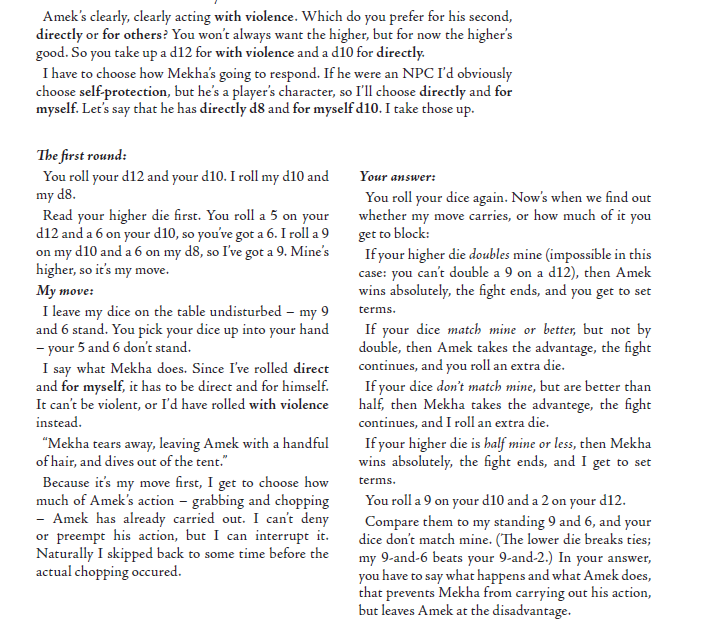
Everyone was very patient with me as a GM, but frustration grew as we continued to second guess when something was definitively true. We don’t know if your move actually happens until we see how everyone else answers. Further, in any given round, it may seem like someone is going to reach their goal, but until either an answer yields a definitive result (double or half the standing dice) or the end of the third round, what really happens is uncertain.
This led to situations like “I knock Mizra away from our waterskins and push him down down the sand dune, standing between him and Ashur.” and then finding out (because both of the answer rolls were higher) that Ashur wasn’t blocked and that Mizra kept his hand on the waterskin. So all the fiction we thought was established was immediately changed and we realized the “move” was more of setting up the challenge for others to prevent. The more accurate version of the statement would have been “Unless you challenge me and best me (rolling better than I did), I propose to knock Mizra away from our waterskins and push him down down the sand dune, standing between him and Ashur.”
I think that now that I’ve run two sessions, if I were introducing In a Wicked Age to a new set of players, I’d have a better handle on teaching it as well as facilitating conflicts and setting expectations around outcomes.
Play style
The other challenge for our group is that while I character are often at odds, they are rarely taking actions that cause harm to the other. We disagree, we don’t necessarily fight. In Polaris we had to fight (you sat across the table from your antagonist) but we were often using NPCs are the vehicles of our antagonism. Rarely did the characters that we adopted as our our singular avatar in the game truly come to blows.
In Mountain Witch, we could betray each other, and that betrayal could change outcomes, but rarely were we facing off against one another directly. The antagonism was chiefly pointed towards the external threats, aka the GM.
In a Wicked Age is very clear that the players Best Interests should be an attack on another character. While NPCs were present, it very much felt like the meat of the game was the conflicts between the player characters. In the first session this created frustration because one character trying to get another character to change their mind proved impossible. Demet’Hereesu could shut down Beletsunu’s bath house and only offer to open it back up if she allied with him, but he couldn’t actually make her agree to be his ally.
In the second session we did have characters that were more yielding, but it was the NPCs that were willing to change and bend. The Water Tribe hunter Walita (NPC) wanted to end the lineage of the Sand Tribe, but when she was defeated and the princess Jila (PC) offered her mercy, she decided that the princess was different than her father, and should be given a chance. Similarly when the ghost Hadir Ban (NPC) tried to possess Jila, the daughter than strangled him, and she managed to smash the medallion that was both the sign of his office and the vessel for his ghost, he lost all power over her.
Conversely, losing water to Mirza (who was trying to kill them, but was a six year old child and had no way to fight them, so instead he stole their water) felt like a major blow. At the end of the day, being in a knife fight with each other wasn’t fun for the table.
What problem are we solving?
At the end of sessions we like to consider what problems a game is trying to solve. What is it trying to get players to do? I think In a Wicked Age was trying to do three things:
- Force players to take actions, rather than use words, to convince each other. The conflict system is explicitly never being engaged when people were just talking. Action is required to pull the dice out.
- Train players to fight hard for their best interests, but hold onto them lightly, and be ready to have your character change. Most players won’t keep playing the same character from session to session, and since you may only have your character for a session, let them get messed up and change. I think it’s also highlighted by each player having a best interest that is harmful to another character, so you know before play starts who is gunning for you.
- Give players permission to go hard at each other.
I like these ideas, but they caused a lot of friction and frustration at our table. I think I’d run In A Wicked Age again with another group if I knew everyone was excited for both throwing daggers at each other, and being impaled by said daggers.
Those were my heady thoughts, here’s the actual play report.
Mirza on the way to Nikanuur
We set this game a year or two before the last session, when Mirza (not yet possessed by ten rival spirts) was wandering the desert after his parents were killed by the soldier Ashur after they refused to offer him lodging. Ashur stole the war chest from his people the Sand Tribe and deserted his post. He was joined by Jila, daughter of the Sand Tribe King Hadir Ban. She strangled her father to death and fled with Ashur, disguised as a soldier. Both had committed heinous deeds and were being hunted and haunted for them.
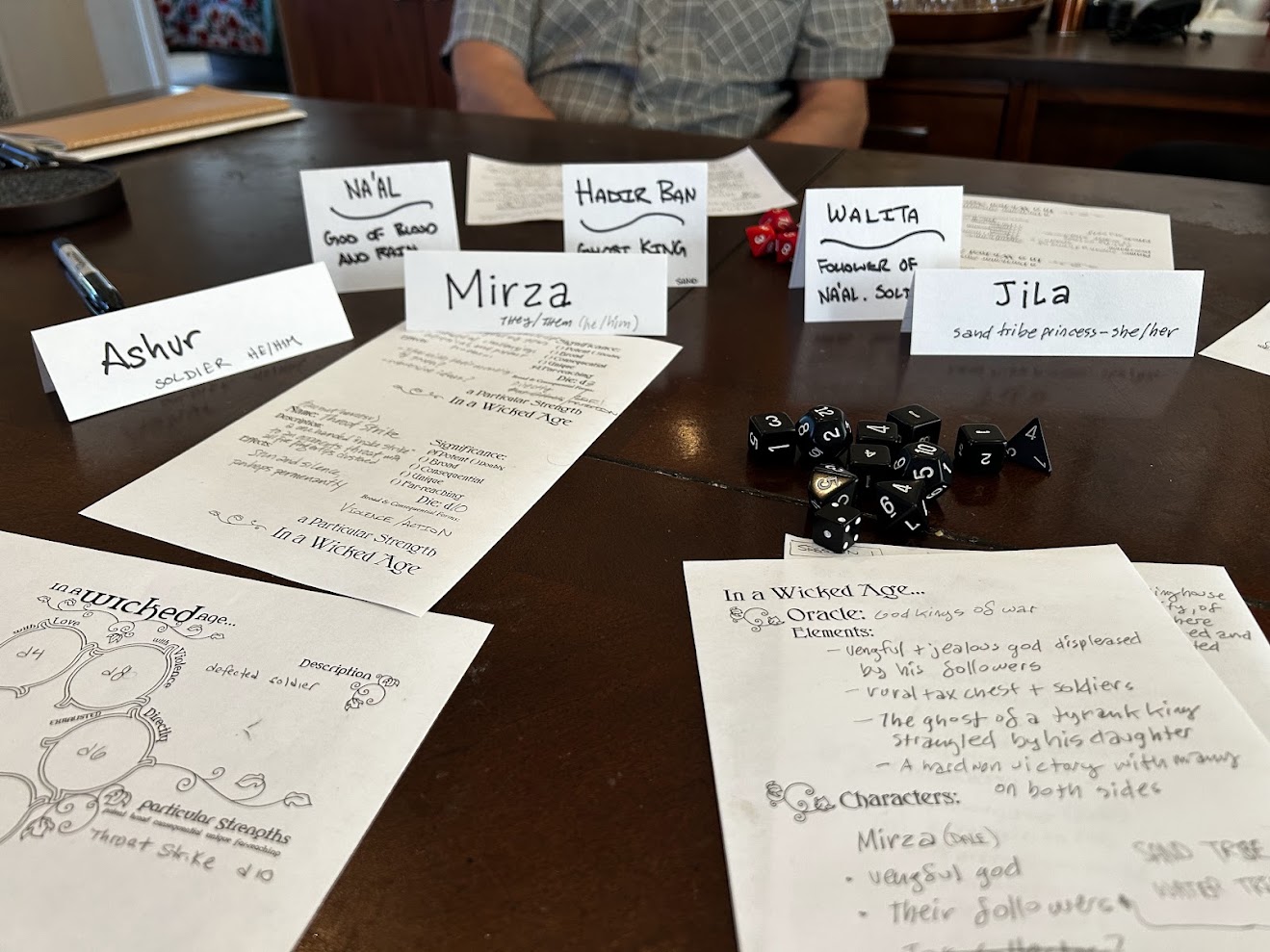
Oracles (from God Kings of War):
- A vengeful and jealous god, displeased by the lapses of his followers, however scrupulously they observe.
- A chest containing the tax monies of a rural province, and the soldiers carrying it.
- The ghost of a tyrant king, strangled by his own daughter.
- A hard-won victory, with many dead on both sides.
From those oracles we derived these characters:
- Mizra, carried over because he was on the top of the Owe List from last session. (Dale)
- Na’al, god of Blood and Rain. Patron of the Water Tribe, but disappointed in them despite their victory over the Sand Tribe. Determined to turn the child Mirza into a bloodthirsty killer.
- Walita, follower of Na’al, determined to end the last lineage of the Sand Tribe’s leaders and recover the spoils taken by the derelict solider Ashur.
- The soldier Ashur, derelict in his duty and making off with the wealth of the Sand Tribe, transferred from a large chest into overstuff saddle bags. He intended to ransom the princess Jila and lose the child Mizra in the desert. (Karen)
- King Hadir Ban, now dead and haunting his daughter, who he sought to punish for her betrayal and for the weakness she showed towards her people, lowering herself to care about them.
- Princess Jila, who saw her father as they tyrant that he really was, and strangled him to death in his sleep. She wanted to turn Ashur into the hero the prophesies spoke of, and banish the spirit of her father (Matthew)
I just fucking love this setup. All of these characters have so much oomph. Literally any of them could have been player characters, and I could see other possibilities like the tax collector, robbed by his soldiers, or perhaps leading them. What about the ghost of the dead on both sides of the war, lamenting the folly of their greed? Who doesn’t want to be a ghost dad?
Death by depravation
Mirza parents had denied Ashur and Jila at their door. It was not the hospitable thing to do, but the war between Sand and Water tribes had made people wary. Mirza’s parents were members of the Water Tribe and they could see Ashur and Jira’s wearing the yellow and blue colors of Sand Tribe soldiers. The fact that they were laden with gold and hungry for a place to hide made them seem that much more dangerous. Mizra’s parents should have known it was better to invite danger into your home than to send it away, as the soldier Ashur slew them both and took what he needed.
Days later the soldier instructed the princess Jila to walk single file with their pack mule, laden with treasure behind them. From it’s back were pom frons that brushed through the sand to conceal their trail. And yet, with all these precautions Ashur could not help but wonder if they were being followed.
And they were!
The child Mirza who watched these invaders kill his parents, and now snuck behind them, always just out of sight, plotting his vengeance. Though a child, the vengeful god Na’al whispered in his ear.
At night he snuck up on their small camp, a lean-to made of a thin sheet draped over the sleeping mule. When he pulled back the sheet he saw both the saddlebags laden with treasure, and the packs that contained the soldiers waterskins. Though they had more wealth than he could imagine, Mirza was guided by vengeance, not greed. He was planning to take just one waterskin, but the god Na’al whispered in his ear “Why not cut the other skin open to feed sand and starve your foes?” A new plan was formed.
Mirza plunged his small blade into the water skin and in a flash Ashur was awake, his hand clasped on Mirza’s so he could not withdraw the knife and the the water spill.
Jila woke, startled at first, but when she gained her senses, she saw the thief was but a child. She pushed him back, away from the water and down the sand dune they were camped on. She stepped between him and Ashur to prevent the soldier from harming him farther.
But Ashur could not so easily be dissuaded. He push past the princess and ran after the child.
And rightly sow. Mirza revealed that his deft hands had snatched the other waterskin and he made off into the night with it!
[Mirza won the contest and inflicted the Exhausted condition on both Ashur and Jila as they were reduced to a single waterskin, and an punctured one at that. Na’al never had a say in the contest, but if he had won, the remaining water would have turned to blood.]
Burying the Treasure
In the morning Ashur wanted to hunt down the child, but Jila convinced him they should bury the treasure so it wouldn’t slow them down and so that if they were caught, it wouldn’t be lost. Secretly she hoped the warrior would forget about the treasure and that she could return it to her people, but for now burying it was a first step.
As they worked to bury the gold, Ashur talked to himself out loud, wondering if Mizra saw the treasure in the night. If anyone knew, they couldn’t be allowed to live. They marked the location so they could find it again.
They had transferred the remaining water into a chalice and kept that safe as their most precious treasure.
Meanwhile Mirza had doubled back and watched from a fall off hill. Waiting to see what they would do in the day.
Walita Approaches
Mirza saw the camel rider on her way, accompanied by a large lizard that licked the air to help her find her prey. She wore the red and blue of the Water Tribe and carried both spear and bow. From atop the hill he called out and pointed her in the direction of Ashur and Jila. The young child would harry them again.
Walita came upon Ashur and Jila just as they were about to finish burying the treasure. They stood in front of it with the hopes that she would not notice.
Walita stopped at bow range and called out to them. She did not yet know these were her foes, just that the wore the colors of her enemy. Ashur called out that they were just soldiers from a defeated nation and they wanted to trouble. But trouble they would find.
Walita closed into spear range and made an offer. “Sand Tribe. Leave your possessions, walk away, and I will let you live.”
Jila hid behind the mule while Ashur charged. He moved with such speed that he took Walita by surprise and knocked her from her camel. She landed hard in the sand.
Walita raised her spear, but Ashur was upon her. He cut the haft with his sword and put the blade to her neck. “You are a skilled warrior. Only because the princess betrayed her king, did we defeat the Sand Tribe.”
Ashur looked to Jila. Walita followed his eyes. Ashur looked back to Walita and was about to slay his enemy, but Jila called out, revealing herself as the princess.
“I am not the tyrant my father is. You can go on the same terms you offered us. Leave your possessions and take your life.” The left her with not quite enough water to make it to the next encampment and the broken haft of her spear, and took the rest. Walita is unrelating [Her particular strength] but she was also moved by this act of mercy. She removed the best interest “End the lineage of the Sand Tribe.”
Haunted
As they finished burying the treasure, now with Walita’s camel (though not her lizard companion, which followed her) and supplies, the wind refused to comply. Each time they shoveled another pile of sand on the last of the treasure, the wind blew it away. Suddenly a gust was upon them, a sandstorm that only encircled Jila.
The blowing sand took the form of her dead father. “You betrayed me like a coward and then gave mercy to our enemy? I am ashamed to call you my daughter!”
Jila was not hurt by his words, she had heard them all her life. “You were a useless turd in life, and worth less in death. You were a tyrant to your people, I will be their leader.”
Enraged the sand spun faster and faster and flew into Jila’s mouth and nose and ears as her father Hadir Ban tried to possess her.
Jila began to frantically dig up the treasure she had just been burying, searching for her father’s medallion. Even as she dug, she began to lose control of her body, her father fighting to control her in death as he never could in life!
Ashur saw the strange phenomena and realized Jila had been afflicted by some spirt. He tried to strike her with his pommel to knock her unconscious but the sandstorm pushed him back.
Finally, just as the last she was about to lose control of her faculties, Jila found the medallion her father had worn, just as his father before him, and his father before him. She clutched a rock and shattered the gem that lay in the center, banishing her father and ending the last symbol of his legacy.
Adrift in the spirt realms, Hadir Ban floated on the desert winds until he felt himself pulled to another anchor. The young boy Mirza, already possessed by the vengeful spirits of his slain parrents!


.
Thoughts on the game
Much of it is captured above, but I also have to say, this was such a fucking cool story. What would become of Ashur? Of Jila? Of Mizra? In another session we might wonder the fate of Walita or her vengeful god Na’al, just as infuriated with her as Hadir Ban was with his daughter!