GM: Sam Tillis
Players: Adrienne Mueller, Dylan Arena, James Lawton, Sean Nittner, Sarah Terman, Matthew Fisher
System: Pendragon, 6th Edition
We missed a month due to illness (thankfully our healthcare is better than the knights had!) so we needed a fair bit of recapping to remember where we were.
Knighthood, in the era of King Uther Pendragon! You are young, and the future is bright. If Britain is fractured, lacking in a High King, then what of it? For there is glory to be found, in violence and in love, in politics and in war. Even now, you march with the King and his bastard son Madoc towards the Saxons of Sussex. There King Aelle stands like a rampart, protecting the Saxon holdfast of Kent and King Hengest, the very schemer who treated with the tyrant King Vortigern to open Britain to Saxon colonization a generation ago. Perhaps, if God or the gods are on your side, you can dislodge the Saxons from your fair shores once and for all.
Fairy folk and Saxon raiders; wonders and death. Such is the fare of a knight. There is more that happens in the Year of Our Lord 485, but these are minor things: border patrols and bandit raids, pleasures and pains. King Uther and the bastard Prince Madoc retreat to winter in Londinium, while you sleep each night in the great hall of Earl Roderick in Salisbury. And so a Winter passes and brings you into the year 486.
As services of our lord, we marched into battle under the banner of Uther Pendragon and his son Prince Madoc to break King Aelle line so we could take back our lands. Our young knights felt full of valor. Sir Moris however, felt this was the moment when he would prove himself worthy. His silver plate craves deeds!
Marching for Sussex
On the way, each knight had the opportunity to seek council or solace from others.
Sir Henry approached Sir Miles asking for advice in battle.
“Only one rule of war. Don’t die. Valor cannot be earned if you are dead.”
“I’ll either learn that quickly, or not at all.”
“I wonder Sir Henry, if there is anything in this world you take seriously?”
“Yes, Sir Miles, but my skills only lend themselves towards one action, and I am not sure how that will be help to me on the battlefield.”
“Think of your sword as, well, something else.”
It took a moment for the notion to don on Sir Henry. How he had never compared his sword to his member before was impossible to imagine. But now that he had, it opened up a whole new realm of possibilities “Ah, so I just need to fuck them all in the face with me sword. I got it!”
Sir Miles wasn’t sure that he did.
—
Sir Gregory approached his brother Sir Caradoc to give him words of encouragement and see if this was the time he would invite god into his heart. “We’re about to go to our first battle.”
“You’ve been well trained.” Sir Caradoc assured him.
“God-“
“God is definitely not on the side of the Saxons.”
“Yes. Would you like to pray together. For the benefit of our companions?” Gregory hoped this later justification would appeal to Sir Caradoc.
“If you think a prayer will help your courage, I’ll sit with you?”
“And pray?” To our lord?” Gregory looked hopeful.
“My experience is that he doesn’t listen.”
“Oh. He listens to all. Please-“
“I will sit with you.”
Sir Gregory’s smile fell, but he did close his eyes and fall into prayer with his brother at his side. He felt the light of the lord fall on him, leaving Sir Caradoc in the shadows.
—
Sir Elias asked Sir Idwel, one of the mercenaries he still believed to be fey knight if it was normal to feel strange urges just before battle. You know, a heat that grows inside you, a desire for companionship in the bed. Sir Idwel thought he knew what Elias meant and then suddenly realized he did not, and shuffled his horse a few paces away.
“No young knight. I’m not familiar with that, but I am familiar with another craving. That of loot!”
“Why the lute?”
“Loot! Plunder. Bounty.”
“I’ve never been good with money, that is the stewards job.”
“Yes, but one day when you are lord of your own lands, you will need it. The only way to be true to oneself in this world is to swear allegiance to only one thing: gold.”
“No, that cannot be right Sir Idwel. My allegiance is to the lord God, my lord Roderick, and then to my family. They give me purpose. They guide more sword. Without that, I would know nothing.”
“But without loot you will have nothing. Your family home, your lord’s keep, your great cathedrals. They all require plunder to build and sustain them.”
“That may be true, but I know not of such things. If I find plunder in this battle, may I give it to you so that you can help support my family and my lord?”
“Give it to-“
“To help my family.”
“Ah yes, of course young knight. I would gladly carry that burden.”
—
Sir Moris approached his liege Sir Owen and asked him what to expect in battle.
“Expect Chaos. Bloodshed and shouting coming from all sides. Return to our banner if you are ever unsure.”
“These Saxons. I have heard so many things about them. Some compare them to animals, while others say they are the devils themselves.”
“The are neither. They are men. Sometimes weak, sometimes strong. Sometimes kind, sometimes cruel. But always men, just like you and I’.
Battle of Mearcred Creek
Before the battle Sir Bruce approached Sir Gregory. “You’ve trained hard. You’ve learned to ride and to joust and to fight with your sword. But the only way to learn leadership is to lead. I want you to lead our conroi in battle. Gregory did not feel ready for this assignment, but would not refuse it. He prayed that he would lead his companions well.
Before battle we all said what we were fighting for:
- Homage to Earl Roderick
- Love of Family
- Love of Rome
- Hatred of Saxons
Good reasons all around, which filled us with the will to fight [Averaging all our passions, we started with 17 morale]
King Uther rode out in front of us and made a speech. “We go to war with the Saxons, pillagers of our land. You have but one goal. To kill them. Kill them all!”
And with that we charged into battle! Most of the battles we chose, some of them were thrust upon us. We fought, in order:
- Fearsome Heorthgeneats. Well trained and armed Saxon warriors who broke some of our charges with their spears. Caradoc, Moris and Gregroy’s steeds were harmed in the battle but they survived and healed from the wounds in the months to come. Sir Moris of course was the best of us, slaying not one but two of the mighty Heorthgeneats.
- Frightened Peasants. These were English peasants who had been captured and forced to fight by the Saxons. They used hoes and trowels and were rightfully terrified as we charged. Sir Gregory asked that we all find mercy in our hearts and scatter the peasants who clearly fought against their will. Though Sir Hew said we were being foolish, Sir Gregory devised a plan to come at their flanks and drive them into the river and the brambles, so they might chased off without being killed. This plan worked with some success. Of course Sir Moris terrified all who beheld him. But Sir Henry was knocked from his saddle and kicked in the face. When that happened Elias’s blood boiled and he charged at those who he thought might slay his brother. Sir Henry stood to fuck his assailant in the face with his sword, just as Sir Miles had told him (or at least as he had understood the instruction). A few of the slave peasants were slain, but nearly all were driven off as Sir Gregory had commanded.
- Saxon Ceorls were then suddenly upon us, fighting with spear and seax. We fought them three to one and as we could not charge, their numbers posed a threat. Sir Caradoc was unseated from his horse and his nose was broken as his helm barely saved him from a seax being buried in his skull. In the next battle he sat out while the chirurgens tended to his wounds. Once again, Sir Moris was the most valorous, slaying many with his sword and lance.
- In our fourth round of battle, we spotted a great berserker wielding a two handed maul and battering another knight into submission. As we spotted him, we saw it was Sir Hew! The Elias hated Sir Hew with all his heart, this somehow made him feel that much more responsible to come to his aid. “Great Saxon warrior. I am Sir Elias, son of Sir Liam, and I challenge you to duel.” The great bear of a man laughed at the gesture, but accepted. “Climb down off that pony and fight me face to face. If you lose, I will take both you and this other knight prisoner!” Elias accepted the terms but had to ask Sir Hew for his sword. Elias had lost his in the battle against the Ceorls and did not yet have a squire to retrieve it. Sir Hew reluctantly handed it over. Later he would say that Elias was both very brave and very foolish. He was not entirely wrong. The duel was a savage one. Elias charged in and hacked at the man, but though his sword bit flesh, the great man was unphased. He smashed Elias with his maul, breaking his ribs. Elias was so full of valor, he charged again, right into a feign and the berserker clocked him in the head, giving him a concussion. The berserker told him to yield, now was the time to surrender and live. That was the smart move, but as Sir Hew said, Elias, barely conscious was both brave and foolish. He also had the aid of Sir Gregory and Dame Aurelia who channeled their passions to give him strength and strategy. Elias staggered, in part because of his injuries, but he was also taking a trick for the Saxon’s book and feinting to create an opening. As the maul swung down, Elias lunged forward and buried his blade in the chest of the berserker. The great man fell over unconscious, and Elias fell on top of him, barely awake himself. Sir Hew, who had demanded Sir Caradoc give him his sword and planned to break the rules of the duel, raced over just as the giant fell. “We should take him prisoner.” Elias agreed, and he took a bear tooth necklace from the Saxon as “loot.” Sir Hew nodded “You’ve learned well.” Elias died a little inside when he heard that. Was he becoming the hateful Sir Hew? After the duel, the other knights joined battle with the Ceorls but few perished in the battle.
- In the final salvo of battle, the wounded Sir Elias retreated to the headers while his companions bravely faced another battalion of fearsome Heorthgeneats. The knights fended off the Saxons, and blows were traded, but few fell on either side.
The battle was won the the Saxons routed, but the victory felt hollow in our hearts. The Saxons retreated behind the tree line where they would reemerge next spring. The peasants we spared would be rounded up and sent to fight us again. One who nearly caved in the Henry’s head hoped that would earn him freedom, but it only earned him death. We each claimed one librum worth of plunder from the battle.
This sentiment was shred by King Uther and Lord Roderick. Each of them wanted a more decisive victory than we had. We could not help but feel as though our brave deeds were somehow diminished by how little the accomplished in the end.
Prince Madoc At Camp
Aurelia was denied access to the prince at the court, but social structures are less rigid in the camps of battle. “My liege” she greeted him.
The title was not yet earned and he did not take it well. “Dame Aurelia. Do you know why we lost?”
“Those who do not know the worth of the Roman blood that runs through our veins. The very peasants that-“
“We did not lose because of the peasants. We lost because the lords who did not make it to battle. Duke Gorlois of Cornwall, holed up in his castle at Tintagel, laughed and made merry as we fought with sword and spear. Had all the kings rallied when my father called his banners, our victory would have been decisive.”
“Then I shall endeavor to ensure that all of the lords, starting with Duke Gorlois, heed your father’s call in the future.”
Sir Madoc nodded as though she spoke of fairy tales, but did not dismiss the possibility. “Fight well Dame Aurelia.”
Later in the battle, Sir Madoc would visit both the bed chambers of the wounded Sir Elias, who after all, fought so bravely against a berserker. When Dame Aurelia sought him, he was not to be found.
Prisoner Aethelswith
Deep in the dungeons of Roderick’s keep, Sir Elias visited his prisoner, a man who learned was named Aethelswith. The Saxon had little regard for Elias, despite their battle together “My king will not ransom me. You can either let me rot in his dungeon or kill me know.”
“I have seen you fight in battle. You fought off half a dozen knights. Does you king not value you?”
He grunted. “I needed to fight of half a dozen plus one.”
“I bested you in combat because God guided my hand, but there is much I would learn form you if you would train me. You’re people may not care if you live, but I do.”
He laughed at the idea of helping a Britain to fight his fellow Saxons. Because he would not yield, Sir Elias came to respect him even more.
Wintering in Salisbury
King Uther and Prince Madoc returned to Londinium, but our knights wintered in Sarem. Each of them presented opportunities and favors along the way.
Sir Moris, at the Yuletide feast heard visiting knights speaking ill of Lord Roderick, mocking the very lord who offered him hospitality. He confronted the rudest of the lot and told him he was being unknightly and challenged him to a duel. Without begging leave or announcing his absence, the visiting knight fled, his tail between his legs.
Aurelia also heard unkind wonders, about her brother. Rumors that he believed it was not him that was barren, and he intended to prove it by bedding every eligible woman he could, despite his oaths of fealty to his wife. Aurelia, who had never understood her brother’s Christian values, congratulated him on finally making the choice to spread his seed. “Sister, I am shocked you believe these lies, and worse, you came here to compliment me for this dishonorable behavior they accuse me of!” Aurelia tried to shame him for his unnecessary chastity and incited him to such anger that he said words that could not be unsaid “Your empire is dead! I want nothing of it!” They have not spoken since that time, and it is unlikely they ever will again.
Elias spent his time attempting to rehabilitate Aethelswith and teach him the ways of the Britains. He took him on walks the grounds and asked about his past. The effect was to unnerve many in the court and it was not long before Lord Roderick had a talk with Sir Elias. “You need to show the people that you are more concerned with their safety then you are with this Saxon. Elias would have offered the Libra he earned in loot from the battle to help reinforce the walls, but we flashed back to the moment when he gave it to the mercenary Sir Idwell. Instead all he could offer was his strong back to help lift the beams and raise the walls.
Gregory earned the title Gregory the Pious. He spent his days maintaining a local shrine and speaking with the priests about converting his brother Caradoc. The priest said he had been unsuccessful, but believed Gregory had a chance. At a chance moment when Gregory was not in the shrine Lord Roderick commended him for his leadership in battle and granted him another librum in gifts.
Caradoc indeed tended to his bond with Gregory, who was sick for much of the winter due to his poor constitution and an illness that took many. Gregory’s hands were red from the lye he used to scrub the floors of the shrine and his body was wracked with chills. Caradoc filled the gaps in his windows, stoked the fire in his hearth, filled his larder, and in all ways he could, nursed Gregory back to health.
Squires
As winter began to thaw, each of our knights were appointed with squires.
- Sir Elias petitioned Lord Roderick to make Aethelswith his squire. He said that the way to turn this Saxon into a Knight would be to train him as one. Roderick denied the request, but Elias said his petitions to reform Aethelswith would not end there. He discovered Gwinas, his younger brother and soon to be actual squire, creeping into the dungeons with Eli’s sword, planning to kill the Saxon. Through the grate in the door he cursed the man. “What have you done to brother? What sorcery had you performed to warp my brother’s mind?” Many were disturbed by the attention Elias showed Aethelswith, but Gwinas was haunted by it. He was almost passed over as squire. Elias stepped from the shadows and told him “You are not yet a knight Gwinas. You are in no place to interrogate my prisoner.” Gwinas was mortified at being caught. He returned Eli’s blade to him and vowed his service.
- Dame Aurelia was given Vivian as a squire, a boy of 14 who did not believe in himself. Aurelia trained him hard, but after practice he broke down crying. “I will never be a great knight.” She counseled him “You have years to train to become one” but he was not convinced.
- Henry was given Podrick as squire by Sir Miles. He took the young man to bed a woman, just as Henry had done when he was a squire. In Henry’s case he was eager for the experience and Sir Miles though it might get something out of his system (Sir Miles was wrong). In Podrick’s case, he was resultant to perform this right of passage. Henry thought it would delight him, but just as Sir Miles before him, he was wrong as well.
- Moris was given the squire Barnabus, who lost off of his family to illness. Barnabus was eager for adventure and could not wait to follow his knight out into the Forest of Gloom to face a dragon. He wants to prove his worth just as we do!
- Caradoc was given Jasper, the first sone of a minor lord whose household is terribly mismanaged by Jasper’s father. His mother called in some favors so that Jasper would be trained by a knight who was thoughtful and who understood stewardship and logistics. However when Caradoc approached the young man he was staring out the window and took no heed of him. He held out a broom “What is it you’re thinking young Jasper?” It took several attempts to get his attention and then the squire looked at him increduluosly “I’m thinking that I don’t want to sweep.” Caradoc was disappointed “Sweeping is training for using an axe. You must learn to do all of your chores with diligence before you can become better at any of them.” Young Jasper said under his breath “Your chores.”
Weddings, children, and death
At each winter, as time passes, those in our lives change. Gregory’s mother fell to sickness, as did Elias’s young sister. Pridwyn was thankfully spared from illness, but suffered an even worse fate. She was betrothed to none other than Sir Hew!
Moris leaned of the news by waking to find her in his bed chamber (very inappropriate). She looked as though she was doing everything she could to keep herself from crying. “I thought you should be the first one to hear the good news. I am to be wed to Sir Hew.”
Moris was speechless for a moment. When he finally found his words he entreated his love “Do you want this?”
She paused, longing to tell him the truth, and that was all that he needed. He grabbed his sword and ran in his nightclothes to the stables where he found Sir Hew tending the horses. “Sir Hew. I hear you are to wed Lady Pridwyn.”
Hew looked up from the hay to confirm. “I am.”
“The I challenge you for her hand.”
Hew laughed and the young knight, still wiping sleep from his eyes. “Why?”
“Why? Because I love her with my whole heart.” Moris held out his blade.
Hew stepped closer “You don’t love her because you don’t know what love is. Love is suffering. Love is agony. You have a childish infatuation.” When it was clear Moris would not stand down Sir Hew reached for his own sword and advanced.
Their blades clashed, once, twice, then Sir Hew knocked Moris’ sword from his hand and put the tip of his blade to the young knight’s chest “Tell me you know what love is!”
Moris looked at the blade and asked the cruel knight if he meant to kill him.
“I would not kill you as I would not deprive my lord of one of his warriors. You are a valuable asset.”
Moris lunged for his sword and Sir Hew slashed him brutal across the back. Moris fell to the ground, alive but bleeding badly. The last thing he heard was Sir Hew curse himself “Shit.”
Moris woke in the healer’s bed, in the company of his fellow knights and Lord Roderick.
Our lord looked stern, as though he had bad news to deliver. “I heard you challenges a senior knight to a duel. And did not surrender when given the chance to yield?”
Moris looked sheepish, but he would not deny the truth. “It was for the love of a lady. I could not yield.”
“You can always yield Sir Moris.” He paused to look over the convalescing knight “Sir Hew has asked to take a self-imposed leave of absence for a year as atonement for striking one of my knights. I have granted him leave to better understand his actions. Meanwhile the wedding shall be postponed until he returns.”
Moris looked mortified, but also had a shred of hope that he didn’t before. “I am sorry for causing so much Trouble. I-“
“Yes. You should apologize. Don’t challenge one of my knights to a duel again.”
Lord Roderick departed and Sir Moris’ friends all came to grant him succor and tell him what had transpired while he recovered. Elias believed he did the right thing and told him that his wounds would heal and he would once again have a chance to win Pridwyn. Moris lamented that some wounds don’t heal [Which was mechanically accurate, the scar on his back caused him to stoop some. -1 Size]
Training and Practice
Each of us trained our skills and passions. Growing our skills of courtly intrigue and battle. At the end of the year it was Gregory who had the least glory, and when asked what he would do about that by Lord Roderick, he said he would keep following the lord’s path.
Aurelia, who did not have the least glory, but who also did not have the most (that of course was Sir Moris) was chastised by her mother Octavia about what she planned to do to surpass her peers. “Daughter, I have heard of your companions actions, but not if yours. It is not enough. Sir Moris is on everyone’s lips, but they say little of you. What are you going to do do about it?”
“The heir of Constantine. I will impress him so he shines favor on our house. Duke Gorlois defies the prince and I will make him yield.” The plotted a scheme to get Aurelia in a room with Duke Gorlois so she could win him over.
Elias, who was in a middling state of glory was not overly worried by such things, but Sir Hew’s charitable behavior to Sir Moris gnawed at him. He approached the veternan knight before he departed. “Why did you choose this self imposed exile Sir Hew. I have never known you to be a charitable man.”
“It was not an act of charity. I have set a trap for Sir Moris. He will learn what love really is and be stronger for it. Or he will fail, and he will still learn.”
Elias did not understand his meaning, but couldn’t not fault the man, even though he faulted him for so much in the past. “Very well. I will tend to you lands in your absence.”
Wistenfeast
In the spring Lord Roderick was invited to Uther’s court to celebrate Wistenfeast. Earl Roderick could not attend but he sent our conroi instead. “I ask that you represent me well in Uther’s court.” That was his subtle way of encouraging all of us not to embarrass him or ourselves.
Sir Henry had a network of lovers who shared what they knew of the realm. Once such informant told him before we left that while Uther is Christian, he will use pagan means if he believes they will work. He is, more than anything else, a king.
The Feasting Game
Feasts are a rowdy affair. There is much gorging on delights in celebration of surviving the winter and looking forward to the bounty of thew new year 485. Once a knight accepts an invitation to a feast, they cannot leave without being granted leave by the host, lest they lose great honor and cause insult.
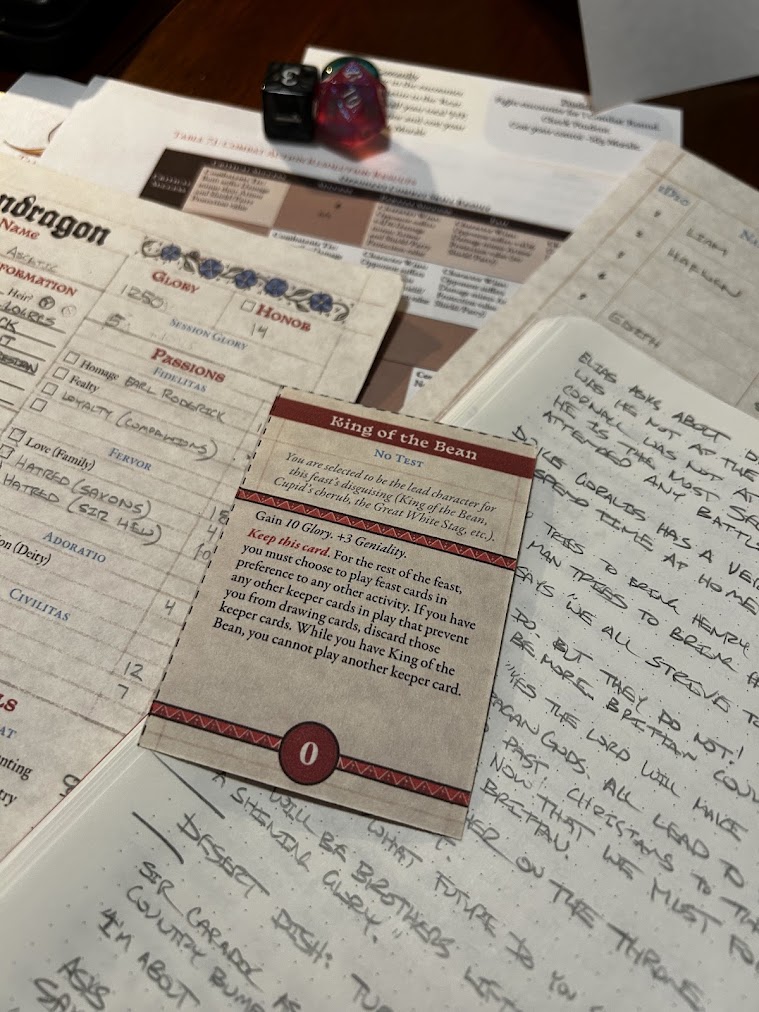
We all determined our geniality and to no one’s surprise by Sir Moris, we were all seated just below the salt, but he was seated at the high table with King Uther himself! [We had to roll our Glory/1000 which for all of us meant we only succeeded on a natural 1. Which of course Sarah did! +1 Geniality]
Carodoc spent some of his bounty to dress in great fashion, he made a necklace of braided leader that was fashionable this season [+1 Geniality] but would be out of vogue by the next year.
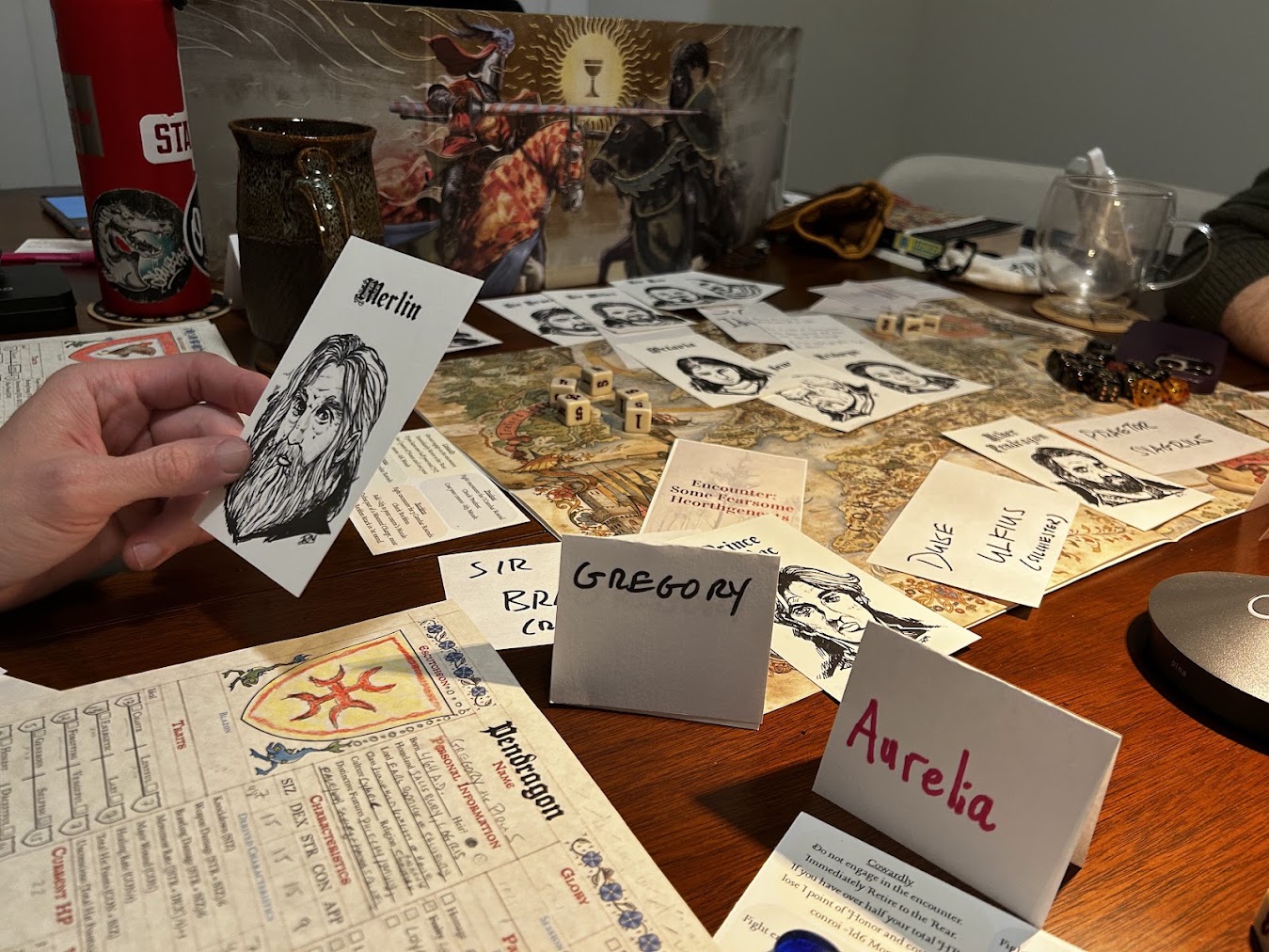
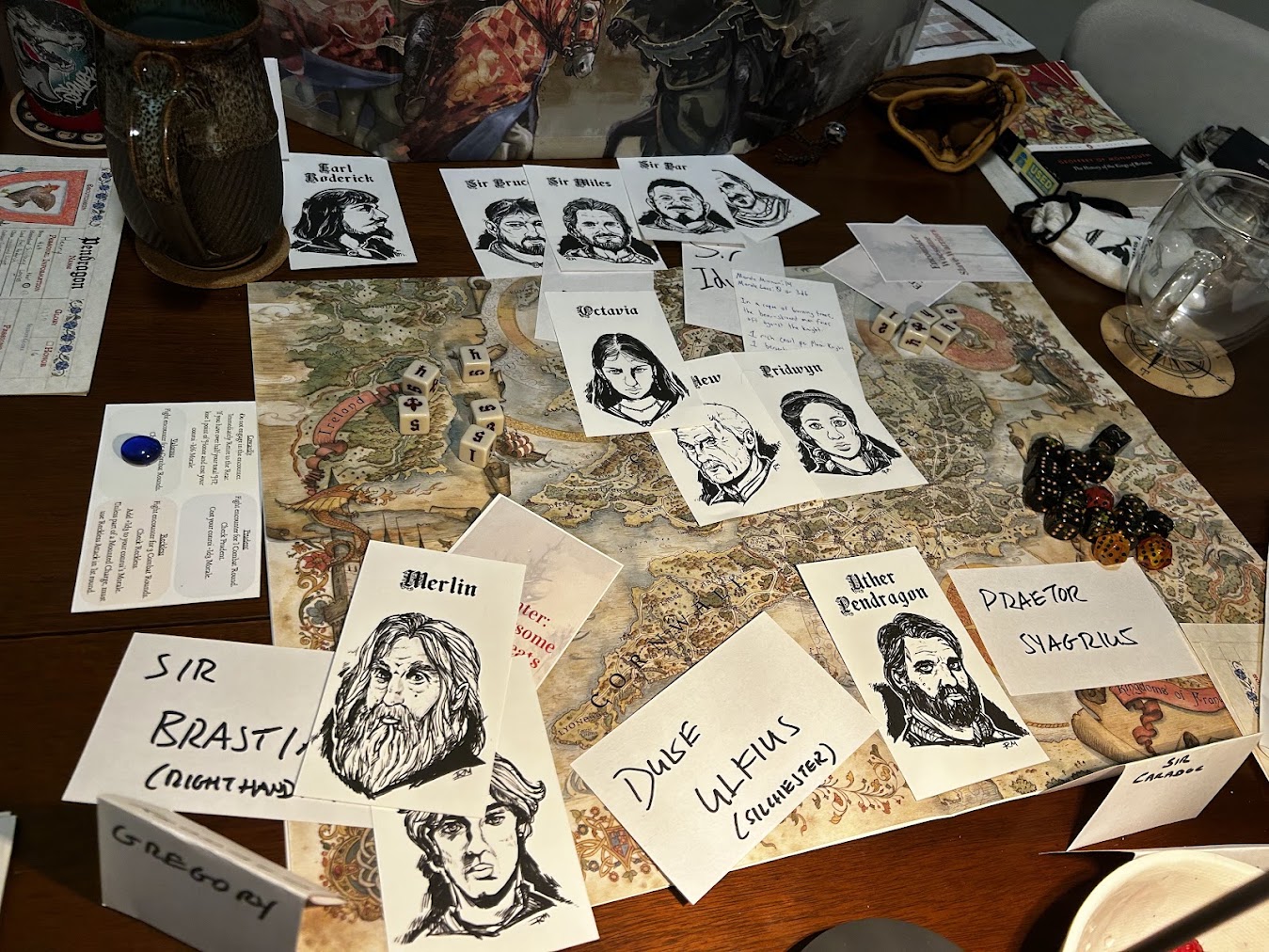
Seated at the High Table were: Uther Pendragon, Prince Madoc, Duke Ulfius of Silchester (who has been at the battle with us), Sir Brastias (who stayed behind to protect the King’s lands), Sir Moris, who felt very out of place, and the Praetor Syagrius, who seemed to be visiting us from Rome!
First Course: Rich Fruit Tarts
Sir Caradoc was approached by a country bumpkin of a knight who had a bandit problem. “Every time I chase them, they just run away, and then come back when we’ve left.” Caradoc suggested the knights lay a trap, posing as unarmed civilians to lead the bandits to them. The knight was unsure of the honor of such tactics, but he agreed they were sound, and would invite Caradoc to help him implement the plan in the morrow. Assuming he lived that long (his stomach was rumbling fiercely). [Gained Geniality]
Sir Moris was challenged to a test of strength by Sir Madoc. “I have wrestled other knights in your court. I would be happy to wrestle you as well Sir Moris.” Moris did not understand the innuendo, but King Uther certainly did. When Moris bested Madoc in a wrestling, the virile prince offered a rematch later in his bed chambers if Moris had the stamina for a rematch. [Gained Geniality]
Sir Elias was asked to tell of a great deeds. He was modest in his retelling of the duel with Aethelswith, and how he hoped to teach the Saxon of God. [Gained Geniality and Glory]
Sir Henry was barked at by angry dogs and got fruit tart on his shirt. Though this gained him no favor in the court, it did get him the attention of a gruff looking man who sat on the floor with the dogs biting meat from a bone with square teeth. Elias thought he looked a pagan who abstained from society as protest of the social norms. [Lost Geniality]
Current Dish: Roasted Peacock
Sir Caradoc led a dance and did it with style. We all joined in! [Gained Geniality]
Sir Moris found a lady in distress, trying to avoid the amorous knight Sir Trevor. Sir Moris rebuffed the knight for his uncouth behavior and shamed him into fleeing the hall.
King Uther called upon every knight in the hall to a toast “Knights of my kingdom. This is a time to rejoice!” Our toasts from worst to best. [The event Elias drew, but it affected everyone]
- “The fruit tarts and serving wenches are beautiful.” – Sir Henry
- “Pentecost is an important date from the bible…” – Sir Gregory
- “Praise Uther and his powerful son Prince Uther.” – Sir Elias [Gained Geniality]
- “To a new year of bounty!” – Sir Moris [Gained Geniality]
- “Last year we bested the Saxons. This year there will be more bounty to come!” – Sir Caradoc [Gained more Geniality]
Sir Gregory found himself getting tipsy. The mugs here are so big and not watered down like the ale in Sir Bruce’s hall.
Sir Henry was challenged by Sir Brastias to debate the best weapon. “We all know the sword is the finest weapon, but when comparing other weapons, I say the mace is the best, it can crush helms, rend armor, and knock foes from their steeds.”
Sir Henry picked a baguette (surely brought by the praetor from Gaul) and knocked another knight from behind his platter held up as a shield. “The axe is best because it can bypass a shield.” [Gained Geniality]
The gruff man sitting amongst the dogs called Sir Henry over. “Is that all your made of. Axes and fucking? Why do you keep casting your gaze on me sir knight?”
Henry wasn’t sure but he found the man compelling. “You’ve made an interesting choice, sitting here with the dogs.”
The man took him in. He cleared some dog shit out of the way and invited the young knight to sit on the floor beside him. Sir Henry joined the man the floor, now cleared of dog shit.
Dame Aurelia, when asked the same question, said that without question, after a sword, the mace is the superior weapon.
Sir Caradoc was challenged by a crone to perform a feat, however the story he told about the fey woman he fought did not impress her. “You did not defeat her” the crone said cryptically.
Sir Moris, like Gregory, had too much to drink.
Current Dish: Mushroom Tarts
Sir Elias, after much drink and boasting, abstained from a feast event to inquire about the reluctant Duke Gorlois [Choice to make Intrigue test instead of drawing an event card. Critical success.]
He learned two things. The first, which is what we all suspected, the duke’s lands are the most secure and he has no fear losing them. In fact he has never attended any of King Uther’s battles. The other reason he rarely leaves his lands is because his wife’s beauty is unsurpassed and he spends much of his time with her producing heirs.
Sir Gregory tried to call Henry back to the table, but instead he was called to join them on the floor. The gruff man asked Sir Gregory what drives him.
“We all strive to be better.” Sir Gregory looked about, believing this was true of all knights.
“You do. But they do not” the man waved his turkey bone at the other knights in the hall. “You know this could be more. Britain could be more!”
Gregory, initially put off by the man, now was growing fond of him. “Yes, the lord will make us better.”
“Your lord. The pagan gods. All lead to the same place. Pagans look to the past. Christians look to the future. But it is the now that we must focus on. What we make Britain in the now.”
Sir Gregory nodded. “We must put Uther on the throne.”
The unknown man agreed “That is a start.” He could clearly see more that was shrouded from our eyes.
Henry inquires “What future do you see?”
“It will be brothers lifting each other up. Not fighting over lands, but working together to create something worthy of shining glory.”
This seemed an intriguing notion for Henry. He decided that he liked this man.
Sir Caradoc was asked by the country bumkin knight (the same one who asked him about fending off bandits) to entertain his new beautiful wife. “I’ve had to much to drink and I’m about to throw up. Can you please help me?” Caradoc agreed to keep the knights wife at his side, but when he approached his friend gathering among the dogs, she was cast off by the gruff but erudite man.
“You, go! You, stay!” He said casting off the young wife but calling Sir Caradoc to him. “Sir Gregory says you don’t believe in God?”
“I’ll believe in him when I see him.”
“You are a fool. There is so much to believe in that cannot be seen.” The bearded sage asked Caradoc to count the rings in the tree that made our fine feasting table. “The number matters not. Each ring in that tree, each blade of grass in the fields, they are all evidence of what he (Sir Gregory) calls “God”.
Dame Aurelia, cautious of impropriety, sat at the table closest to the salt and spoke loudly about the goddess Venus and sexual exploits so that Prince Madoc could overhear. Surely enough that dew his attention. He would visit her again when the feats was finished. To feast again!
Current Dish: Turnips baked with cheese
Sir Moris was asked if he believed in fairies or spirits. He told the story of the enchantress in the woods, but got muddled up in the details, focused on the boring parts of the story, and lost his audience.
Moris, after the story, approached Praetor Syagrius and asked him if he knew who the gruff man the floor Sir Moris’ friends were talking to.
The Praetor looked at the man with annoyance “Ah, the king’s favorite. He can get away with anything, including sitting amongst the dogs by choice.” He shouted across the hall to the man “Archdruid, are you having a nice meal?” but either he could not be heard over the din, or the gruff man who we now realized was the archdruid did not deign his question worthy of response. When the conversation shifted, Praetor Syagrius revealed that he was attending Uther’s court requesting he send knights to help default against the Gauls in the east, but he was meeting with little success.
Sir Elias was chosen to lead a game of the Great White Stag. He took the antlers (which are given to the stag that then much hide from the other knights) and approached the archdruid and his friends. “You look a man of nature. Will you be the Stag and teach these knights a lesson?”
The archdruid looked up a Elias from the floor and appraised him “I will do it…if you accept a quest. Meet me at Midsummer Eve morning at the shrine in Glastonbury.”
Elias accepted the quest both for himself and for Sir Moris. “Sir Moris will come along. If there is a great quest, surely there will also be a dragon!”
The archdruid looked at him with intensity. “You do not know how right you are young knight!” The archdruid donned the antlers, but before he left Henry asked his name. “You can call me Merlin.”
“Martin, sounds great. Nice to meet you. We’ll see you at midsummer.”
As the archdruid lead the chase (not a single knight would find him that night), Gregory turned to Henry and repeated a line from earlier in the night. “You rut too much!” Which started back up an age old debate between them. [Gained Glory and Geniality]
The end of the feast
That night, Prince Madoc confirmed that Moris did not want to “wrestle” again and so he joined Dame Aurelia for a second feast. After coitus the spoke of the affairs of the realm. Aurelia offered “we could get aid form the praetor” but Madoc countered “He cannot offer aid, only more wars to fight.” So instead they spoke how how Duke Gorlois might be brought to bear. Prince Madoc believed that only when his father was made High King, would he finally recognize his son as his heir. Dame Aurelia, now hopefully with Madoc’s seed within her, pledged to make this all so.
Sir Caradoc, the next day met the country knight to help catch bandits. The knight introduced himself as Sir Ector.
Preparing for a Quest
In the spring our knights performed their duties with great vigor. Working late into the night, never laxing. All so that they might beg leave of Lord Roderick for their quest. Their machinations did not go unnoticed and so when he called them together his first questions was “What is going with all of you?”
Elias spoke first “We want to go on a quest for the King’s archdruid.”
“Martin” Henry helpfully added, and Moris corrected “Merlin.”
“You wish to go into Glastonbury in Summerland? Into lands loyal to King Cadwy and not King Uther?” There was a long pause before he continued. “I will grant you leave to do this. Present yourself at the border of Summerland and act with honor in our enemies territory.”
We rejoiced that our lord granted us leave and prepared for the journey.
Sir Elias petitioned to bring Aethelswith on the quest as a chance for the prisoner to learn more of our ways and to prove the honor that Elias knows he has. Elias also believed that if he left Aethelswith in the dungeons for that long, someone would kill him before the knights returned. Roderick consented and Aethelswith, while not pleased by any of the offers Elias made him, came without complaint. When the topic of killing Elias in his sleep arose, Aethelswith confessed that Elias defeated him when he was at his strongest. It had been a year since he had partaken of the mushrooms that gave him strength, now he would not be able to kill the knight if he tried.
Sir Bruce approached Caradoc and Gregory and advised that they be careful of the archdruids wiles. “He will bewitch you if you are not careful.”
Sir Gregory pulled his shoulders back and said “I will protect my companions.” He then went to the shrine, which he had tended to so thoroughly through the winter and asked the priest for crosses and holy water. He offered libra, which the accepted but assured him this was a donation. He would never have to pay for the blessings of Christ. He was anointed with silver crosses and holy water which he shared with his companions, who received it with the expected mix of enthusiasm and doubt. Alas, he did not have a cross for Aethelswith, but the Saxon was unperturbed “Woden cares not.”
Sir Moris looked for a gift to give Pridwyn before he left. A small bauble she would remember him by. He found a fine silver thimble with the imagery of a bird and presented it to her. “Lady Pridwyn, I am again called upon to quest. I am sorry if I have placed you in an awkward position-“
“You have not” she cut him off. “My life has returned to a certain sense of normal, if with some anticipation of the future.”
“I will always think of you.” Moris offered.
“Did you mean to kill Sir Hew? Would you him Sir Moris?” Pridwyn had been waiting to ask this for some time.
“I do not know Lady Pridwyn. I just know you looked so sad that I could not bear it.” He handed her the thimble.
“Sir Moris, I already think if you when I brush my hair, now I will have to think of you when I tend to my sewing. Is there any part of my day that you will spare from thought of you?”
“I intend not to.” Sir Moris said, and departed before he could ruin the moment by saying anything else.
Into Summerland
Our trek on the road was uneventful. We crossed the boarder and soon were approached by six knights. We told them of our quest to meet Merlin and they brought us to their keep to speak with their lord, the Earling Vortidalis. That winter, just as we had lost many, the Earling lost his father, and seemingly almost everyone else in the keep as well. It felt an empty place.
We broke bread with the earling and his knights and after the pleasantries were through, he inquired “I have heard you wish to go on a quest. I have consulted with my advisors (though no one else could be seen) and I have decided to allow you to go, but you must leave your Saxon prisoner in my dungeons.”
Elias tried to convince him of the merit of the Saxon warrior leaning the Christian ways, but did not press when he could see the earling so desperately needed to have his authority be honored. “So be it Earl Vortidalis. Will you vouch for his safety in your dungeons?”
“You have my oath he will be safe.”
That night Sir Gregory was disturbed the sounds of barking dogs and wind. He anointed his eyes with holy water but saw no spirits present. In fact, the place felt bereft of all life.
In the morning we discussed how we could help the young earl, debated telling King Cadwy that he was in need of reinforcements, but when we spoke the earling upon departure, thanked him for his hospitality and offered our as well, Earling Vortidalis made it very clear that he would not beg the king for aid and that he had all that he needed.
We departed to the sounds of barking dogs.
.
Favorite Moments
Holy shit this was so much fun. I love the courtly intrigue between Elias and Aurelia and Madoc and Duke Gorlois (he’ll be a fun one to meet I’m sure). I loved the moments of realization in play as we realized bit by bit that we were talking to Merlin. I loved our squires and their distinct dispositions. I loved getting to put the antlers on the archdruid! There as so much in this game and I’m so ready to play again in a few weeks. But here’s a few of the specific highlights that stood out.
- Caradoc and Ector and all their delightful exchanges at the feast.
- Gregory so devoutly trying to save all our souls and meeting with such varied response. Moris accepted the gifts with humility and grace. Elias wore the cross with the same reverence he offered the necklace of bear teeth, just another bauble. The pagan members of our knights wore (or in Aurelia’s case carried) the cross just to appease Gregory.
- But on that same note, I love how Gregory and Caradoc continue to grow closer even though their beliefs divide them. Like Caradoc is really tryin to get his friend to see past God, but Gregory just can not do it, so instead Caradoc keeps making compromises to be close to him. So much love there.
- Aurelia’s plotting with Octavia to bear the heir of the prince they were sure would one day be king was fucking four dimensional chess at its best. SPOT ON.
- I love how the dice keep telling us over and over the Moris is the best of us. He cannot fail, except when it comes to Lady Pridwny, in which case he fumbles every time (or nearly every time, that last line about filing her thoughts was a banger!)
- Henry seeing everything the through the lens of sex is incredible. He seems the simple knight driven only by his lust, but I know Dylan and I can see there is more there, just showing occasionally in moments of insight.
- Speaking of Henry, as a player I knew that being unhorsed by the peasants was unlikely to be a true danger, but I loved playing Elias who had moments ago told Gregory that he would try to spare the lives of the peasants immediately charge with blood in his eyes as the peasants that threatened his brother.
- Honestly, it’s all of Elias darker thoughts that I love exploring the most. He hates Sir Hew, but had to defend him, then hated it more when he was complimented by him. Then was confounded when it seemed that Sir Hew was merciful on Moris. And again, pledged to protect his lands. Also, he’s so jealous of Henry, but when Henry was threatened he charged at him with abandon.
- Martin. I fucking died.
- Getting the shit kicked out of me, and BARELY besting Aethelswith, then bringing him back to try and become his friend is 100% pure Sean bullshit. I love that everyone is putting up with it. For next game I need to remember to ask him more questions. About his god and the afterlife. About what makes a good life. About family. We spent a lot of time together but didn’t roleplay it, so I’d like to fill in some of those conversations retroactively.
- Prince Madoc fucking slays. He’s the perfect character for driving us. We all want to impress him and have sex with him (okay maybe just Elias and Aurelia).
- I know Sir Idwell is just a mercenary, but Elias has bestowed him with such prominence. I was really fun for me to keep feeding into the idea that he was a knight of the fey woods, and that he would know better than I how to steward my future lands.
- My squire (and younger brother) Gwinas trying to kill Aethelswith because he had ensorcelled Elias. YES. So good.
- Moris and Pridwny makes me want to cry. It’s so beautiful. As a player I am almost tying to get in the middle of things but his is too pure. All I can do is keep trying to bolster my brother in the hopes that he one day he attains his heart’s desire.
- And Gregory as the always sick knight who cares more about God than he does about plunder. I love how he turns to his book and prayers when others would turn to sword and shield. And I love that though he doubted himself he was a great leader in battle. We all have a quest not to kill Adrienne’s character (see all of her characters that died in Masks), but I am also so excited to how Gregory not just lives but thrives.
Mechanics Thoughts
Battle
The Battle system did some things very well, and some things less well, but it rested on the core combat mechanics which themselves are underwhelming me. Breaking this down:
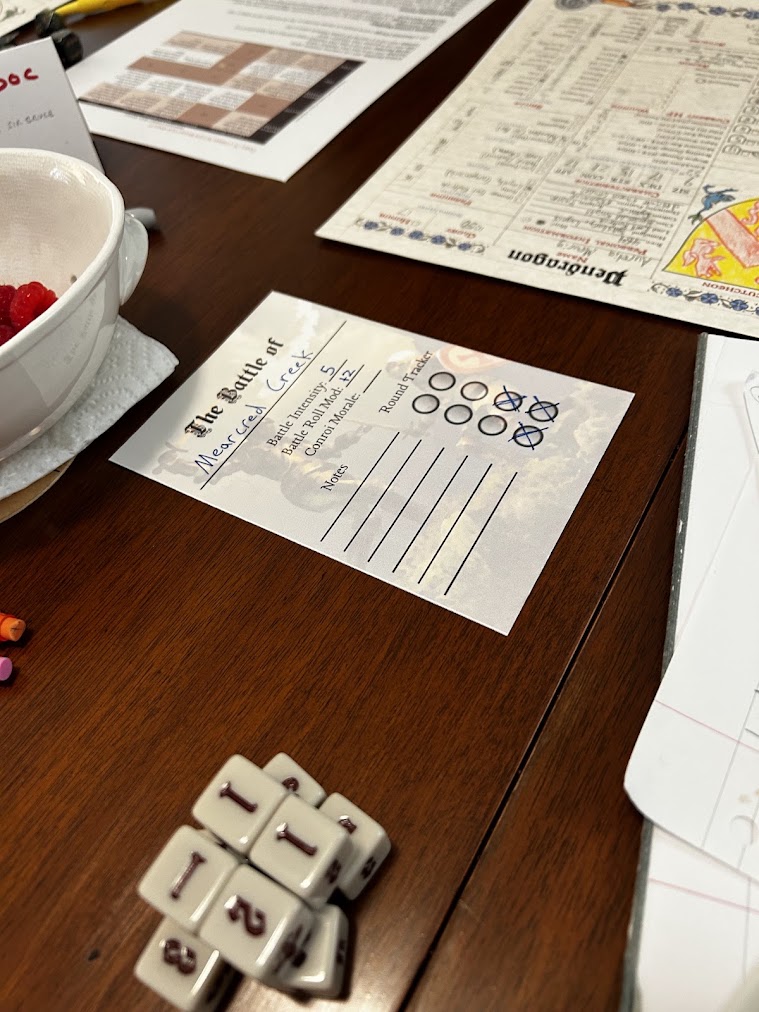
Multiple Rounds. I love this. Each battle has multiple rounds of fighting different units. This battle had five, but it looks like it could go from one to eight. Each round was against a different unit of foes, and only lasted a few rounds of combat before we were swept way by the action. If morale was low, you could flee to the banner to recover, but that meant sitting out a round of battle.
Battle Stance. This is also great. You can sit out of the battle to be tended to, which is not cowardly as long as your beat up. Or you can take a prudent, valorous, or reckless stance, which determines how many rounds of combat you’ll be in. I think the morale boosts and penalties are a bit extreme (winning a battle might gain you 2 morale, but if four knights charge in reckless you get +4d3) but given that entering battles can cost up to 3d6 morale (maybe more) perhaps those boosts are needed. Once your time is up, you can test Energetic to keep fighting or one more round, but after that you’re swept away. At the start of each battle, each knight has an equal number of foes, but if knights fall or retreat the numbers change and can get very dangerous.
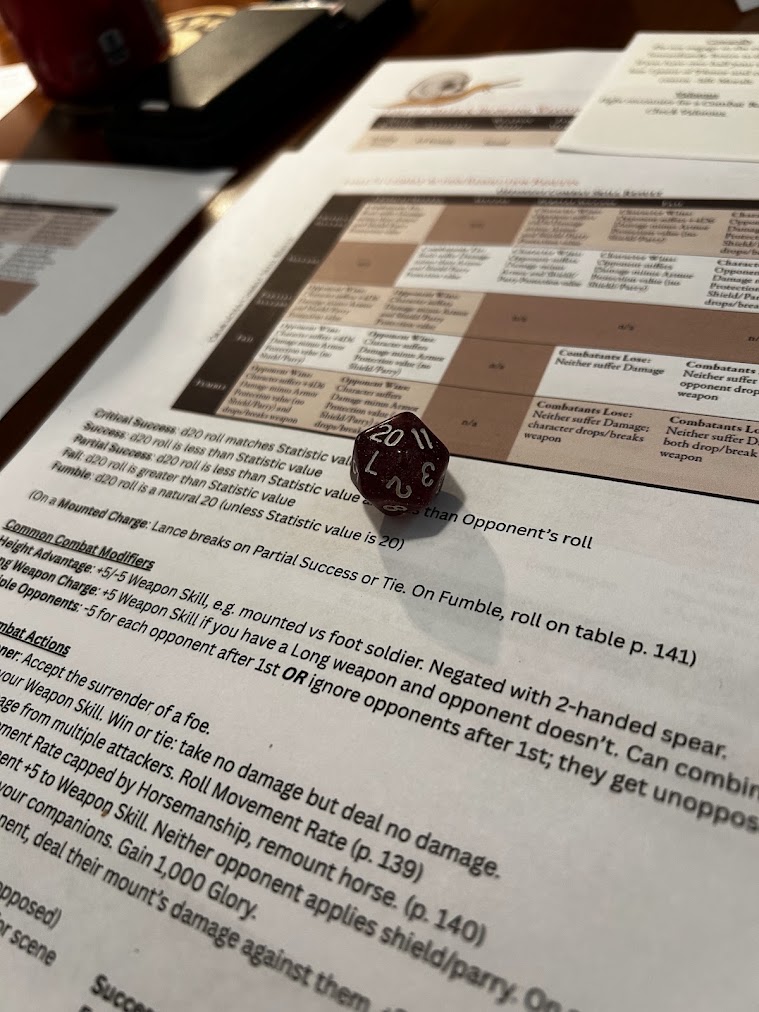
Core Combat mechanics. There are a lot of a factors that adjust rolls (height, weapon length, number of foes) as well as mitigating factors like setting spears for a charge. Given all that, you’d think there would be more tactical decisions to make, but if they are there, we didn’t discover them. We did find a few options like using Horsemanship to circle around for a second charge or to trample downed foes, but these felt like we were pressing Sam to make ad hoc decisions about what could be done rather than use the rules as presented. Once you get past the rote nature of the rolls, there’s also the wild swing of the rolls themselves. You want to roll as high as you can without going over your weapon score. But once you added in the multiple +5 factors, our weapon scores were often 20+, which just meant we wanted to roll as high as possible. And if both sides rolled a success (which happened often) then whoever rolled higher got a success, and the other person got a partial success, which meant they took a blow but got to use their armor and shield. These success/partial success pairs were the most common, and also meant that in many cases no damage was done (as with our shields we had 16 points of armor).
From the situationist perspective, I think this is doing a great job. Most of the time you’re just trading blows that bounce off each other’s armor, and the thing you’re really going for is knocking someone out of their saddle or knocking them down, so that you get a better roll next time and might be able to pull of a crit, which would actually hurt them. But when combat is limited to two or three rounds, the chances of pulling that off are slim. Again, the fact that most foes weren’t killed felt accurate, but not necessarily fun. Having just played Mordheim, I was pleasantly surprised at how quickly people were taking out of the fight (which required a hit roll, then a roll to wound, then a failed armor save, then an injury roll of 5+ on a d6) but only after the battle did you determine if downed warriors perished (which was unlikely, for henchmen, they only died on a 1-in-6 chance. Heroes had a more complicated result, but still didn’t die often). Lots of dice rolling but it was also fast and furious. Pendragon felt sporadic in comparison. You might roll that crit and take our your foe (or vice versa) but more likely you were just going to bang on each other’s armor. It felt both accurate and a little lackluster. I want to give it more time though. We didn’t try any of the combat maneuvers like Disarm or Defend, and I think those might make things come alive.
Arbitrary Badness. The one roll I did not get at all was the 20% chance that the battle just went poorly for us and our leader had no opportunity to do anything about it. While I like the whims of fate, I think those were perfectly well captured in the leaders battle roll. Succeed and you can pick the battle, fail and the the battle picks you. But also, there’s a 20% chance that you can’t make a battle roll at all. It just goes badly, which is the same result of failing the battle roll. I mean if battles aren’t chaotic enough, just lower the commander’s battle skill by 4, that would do the same thing. This felt like a rough edge that never got filed off from the game design.
Winter
Wintering seemed like a good way to handle “downtime” but still add enough roleplaying opportunities that it wasn’t just bookkeeping.
Events Table. It’s only 20 options, but I suspect they are flexible enough that these will keep feeling novel as we roll them each hear. I’m not sure if this was the system or Sam’s lenience, but I was also happy that I could direct my event (time with Aethelswith) while still fitting in the “make a test for a specific thing you rolled” format.
Advancement. So many choices. So hard to decide. I ramped up my Intrigue and Charge because those felt like must haves in this game. But I would have loved to raise stats as well. That can only be done till your 35, so in future years I’m doing that for sure. Gotta get that size up for the glory bonus!
Passive Glory. A bit baroque but I do like that it factors in so many things, your traits, your passion, your appearance, your standard of living, etc. It means that knights can really seek out different paths to glory and they all add up.
Weddings, Childbirth, and Death. This mechanic felt like an odd duck. The more people you have in your life, the more likely they are to be wed, have a child, or die. Given that most of my family were younger siblings, when I rolled my little sister, there was naught but for her to be claimed by plague. The same for Gregory’s mother. This is another mechanic I want to see more of before I decide how I feel about it. At present it feels punishing, though possibly necessarily so.
Getting Squires. Okay, I know this will only happen the first you you’re knighted, but it was so much fun. I loved my confrontation with Gwinas. I loved how Moris had to temper Barnabus. I loved seeing Caradoc struggle to instill discipline in Jasper. Very good.
Betrothals. Roll to see if random NPCs get married. Yes, I love this. And that Moris rolled an 18 for Pridwyn was just more of the dice telling us that Moris life is a tragic one. So good.
No Courting? I’m kind of boggled that there is no official courting mechanic. Or maybe we just haven’t run into it yet. Like, all Moris wants to do all the time, is court Lady Pridwny. And it wasn’t as though he didn’t do that in play, but like how are the rest of us going to start families if we’re always off in the dog shit with archdruids?
Feasting
Feasting. So grateful for this structure. Most games have nothing to “fill up” social encounters. Yeah, you can go to a ball and talk to the prince or whatever, but many of those scenes feel like they take place in void when they should take place among dances, visits for refreshments, speeches, and announcements as important people arrive. I want Bridgeton and most of the time I get a persuade check in a fancy dress.
While each event didn’t necessarily align with our characters motivations, they all felt like things that happen at a feast. Getting to drunk, arm wrestling, telling stories, posturing to be noticed by the high table, meeting archdruids, arguing over what weapon is better, making toasts, and of course, dancing.
We could have done all these things on our own, but because they gained us geniality (and glory) we had had an in-game incentive and more importantly we had a structure for short scenes that felt like they made up a proper feast.
I don’t know that I want every ball or feast or social event to look like this in every game, but I think there are many games that would benefit from creating a dynamic playing field for social encounters that feels as rich as the battlefield does for combat.


God, that “Martin” bit is going to be the death of me… 🙂
Still digesting my own thoughts on the Battle rules. I suspect that the “Battle Intensity as chance players can’t even roll a Battle roll” thing is to stop players who have arbitrarily high Battle skills from just steamrolling the system, but you’re right in that applying it as a penalty is a lot more elegant. I’d already made a couple of tweaks to the base system to reduce the number of rolls in a battle, and this will be an easy fix going forward.
I reserve judgement on the actual combat system. I still don’t feel confident enough in my own understanding of it to feel that I’ve taught it well, so I suspect there is more tactical depth that we’ve only just scratched the surface on. But it’s also equally clear to me that there’s enough going on in Pendragon that there doesn’t need to be a Battle every session: this sub-system’s coming out for truly meaningful battles where external factors shape the battlefield and constrain players’ choices in interesting ways.
*Of course* there’s a courting mechanic. As soon as someone else tells me they’re in the market, I’ll dust it off…
Very excited about all of these characters, and how they’re bending the “canon” Arthur story around their personalities. Literally cannot wait to see how some of y’all’s scheming pays off.
I should have never doubted there would be a counting mechanic! Looking forward to Sir Moris trying it out!